Frequently Asked Questions
Answers by Jules Flesner, the human behind Vermillion + Co.
-
Yes, yes, and yes. Music from Vermillion + Co. is available on Spotify, Apple Music, YouTube Music, Amazon Music, and is also available in your social media app audio libraries.
Love the music? Want to support the humans and stories behind it? Purchase your favorite songs or albums (starting at $1.50) at the Bandcamp artist website or mobile app. Enter a custom amount at checkout to show a little extra support (your “virtual tip jar”).
You can use any Vermillion + Co. song in your social media content including Instagram, Facebook and TikTok.
-
For press or speaking engagements related to music or AI-powered software, submit your request through the Vermillion Design + Co. website’s Media Inquiries page (opens in a new window).
-
No. My songs are not fully AI-generated.
All lyrics, songwriting, and creative direction are human-authored. Licensed AI-assisted tools are used during production to develop the final recordings, guided by my original vocal input and overall artistic direction.
As of now, fully autonomous (AI-generated) music output is rare, if not impossible. Current tools still rely on human input like prompts, lyrics, or creative direction, so my music is better described as human guided, AI assisted.
-
You’re listening to songs written and produced by a human. The lyrics, stories, emotions, and occasional life advice tucked into each track all come directly from lived human experience and human imagination.
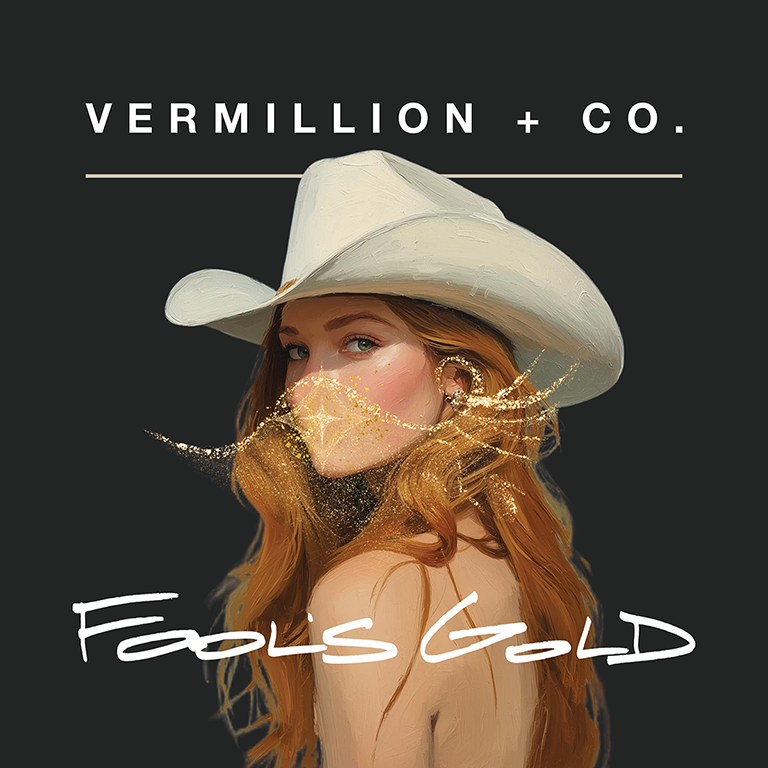
In 2025, I revisited the collection of song ideas that had been living in my head (and various MacBooks) for decades. Recording an entire album the traditional way was out of reach for me financially, so instead I turned to licensed composition software I already had on my computer to shape the songs that became my debut album, Fool’s Gold.
Songs created with electronic and digital tools isn’t new. Electronic music has been part of the music scene since the 1960s. What’s radically different today is the expanding range of software that allows people to experiment more freely with sound.
I was able to layer instruments, reshape arrangements, and blend genres in new ways. I used my own vocal input to guide each track.
Ironically, no other humans were involved in the recording process, which was part of the joke behind that debut album title.
-
Yes and no… I can sing, and, I did use my own singing voice to make these songs. Everything was created and directed by me.
But, what you’re hearing isn’t my raw voice. The vocals were processed using licensed AI tools. Even though they don’t sound exactly like my natural voice, everything is built from my own recordings, lyrics, ideas, melodies, and creative direction.
-
For decades, artists have used advanced tools to transform vocals to the point where they are no longer naturally recognizable:
Auto-Tune and pitch correction
Vocoders and formant shifting
Heavy digital processing and synthesis
For example, “Believe” (Cher) illustrates early mainstream use of the Auto-Tune effect to create a synthetic vocal. “Harder, Better, Faster, Stronger” (Daft Punk) is a great example of vocoder-driven vocals with a fully synthetic tone.
Regardless of audience preference for the sound, this didn’t establish any requirement to credit software as creators. The tools themselves were not listed as “main artists” or assigned revenue splits. They remained production tools under the control of the human artist.
Similarly, current generative AI vocal technology still relies on human input and control. A key consideration is how the tool or service provider sources and licenses its training data. As of today, artists are fully responsible for this due diligence including reviewing terms of service and disclosures to confirm that datasets are properly licensed from relevant rightsholders.
The tool used in my music warrants non-infringement and represents that it has the necessary rights to provide its services, granting full, perpetual, worldwide ownership and usage rights.
-
Short answer: There is no single industry standard yet. Requirements vary by distribution platform and continue to evolve.
In releasing a first album in early 2026, I pioneered a gray zone in music distribution using modern AI studio tools, and ran into conflicting platform policies designed to protect human artists (but in the fine print, found they ironically didn’t support human creators).
For example, one option I explored was TuneCore’s pilot collaboration with Grimes AI. That program required listing the AI as a main artist with a fixed 50% revenue share. That contract would have treated the AI as a co-creator, which was inaccurate and does not align with my perspective (or broader industry views) that AI should support, not replace, human creativity and authorship.Some distributors allow artists to release work under their own name, even when AI-assisted tools are used. Others are introducing stricter rules, especially for generative AI that contributes lyrics, vocals and/or composition. As of today, there is still no universal definition of what qualifies as “AI contribution” versus “tool usage.”
I continue to advocate for credit for my original work as the artist and songwriter, while being transparent about my use of both traditional audio software and licensed AI tools in production.
This includes adding clear disclaimers about tool usage, publishing support pages like this and my Vermillion + Co. official artist Instagram account to explain my process and highlight the real humans and local stories that inspire my original music.
-
It’s hard to pin to one category, but folk is a thread running through my music. A few songs carry strong bluegrass and Appalachian influences. I have my dad to thank for introducing me to this genre early in life and for instilling an appreciation for simplicity and strong storytelling.
I’ve always been fascinated by instruments used in traditional mariachi and Middle Eastern music, so those sounds have found their way into several tracks.
-
Yes.
The song “Mockingbird” (Magenta EP) came to me in a dream one night after spending an evening at Nashville’s famous Bluebird Cafe, where I was front row at an intimate writers’ round featuring some of the world’s most respected songwriters.
Also while living in Nashville, Tennessee, “the” Hank Williams, Sr. appeared to me one night in a dream. He said, “I’m going to play a song for you, over and over, enough times that you’ll wake up and remember it.” Then he started playing.
I remember thinking, “hmm, this song doesn’t sound anything like his signature style. This is more modern, borderline pop.”
I woke up, grabbed my Yamaha Red Label acoustic guitar, the “poor man’s Martin.” (Fitting, since Hank played Martins.) The melody and lyrics were still in my head, and playing by ear I went straight to the chord progressions I’d heard Hank perform.
I wish I could give him songwriting credit, but since I can’t, I gave him the song’s title instead on my Fool’s Gold album.
-
No. Music has always been a passion, not my profession. For the past 30 years, I’ve worked in creative and technology roles.
In 2025, I revisited the collection of song ideas that had been living in my head (and various MacBooks) for decades. Recording a traditional studio album was beyond my self-employed budget, so I turned to modern composition software I already had on my computer.
Additionally, I have sensory processing disorder (SPD), which makes it difficult for me to process lyrics while singing live or while playing an instrument. (Did you know that speech is one of the most complex motor activities in the human body, coordinating hundreds of muscles in seconds to control breath, pitch, and sound?)
Add in the noise and sensory input of a typical live environment, and it becomes more overwhelming than enjoyable for me.
While live music performances aren’t my goal, I do hope to make a positive impact in the responsible commercial use of AI and automated software, and to use my (raw!) voice to advocate for diversity in STEM careers.
For now, you’ll find me chiming in with friends and family on informal jam sessions. I hold so much respect for gifted on-stage performers, and am certainly open to future collaborations and live studio recordings.
-
I founded Vermillion Design + Co. in March 2009 with the intention of always keeping creative agency collaborations alive, whether as a hobby or as part- to full-time freelance work.
After working with some of the world’s most recognized brands including the Swoosh + the Three Stripes, I landed in commercial real estate where I helped pioneer the first technology enabling crowdfunded investing + AI chat tools, and was among the first creative directors in the U.S. to specialize in AI search optimization.
In 2025, I started experimenting with emerging SaaS and the music I’d written. Publishing under a project name felt more appropriate, so I borrowed my long-standing “Vermillion” name.
The “and company” in my design agency reflects the trusted (human) collaborators I call on to deliver award-winning work for clients, a mix of independent contractors and agencies. In the artist name, “and company” is a nod to the different personas my voice can take on when producing music through modern studio tools.
The word vermillion (alt: vermilion) describes a brilliant red with a hint of orange. I happen to be a natural redhead based in Orange County, California.
-
I acknowledge and share the concern of “fake” AI musicians releasing music. It’s unsettling to know that today, someone with no musical background can generate an album with just a few prompts and clicks, releasing it alongside work shaped by decades of lived experience, music training, and human songwriting efforts.
At the same time, I see how digital tools are removing barriers that have historically kept many truly talented people out of music. Recording songs in traditional professional studios and working with producers typically requires money, connections, or both.
People like my dad, who is sitting on a 40+ year collection of original songs and poetry but simply wasn’t born with a strong singing voice. Software tools that create a new, unique digital voice can allow a Top 40-worthy song to be discovered, especially when the goal is pitching it to established artists and live performers.
AI music tools also open new paths for participation for people with speech challenges, mobility limitations, or other barriers to traditional music production. They’re helping neurodivergent creators, including nonspeaking autistic people, share their “voice” and innate musical talents and challenge stigma.
Music follows the same supply-and-demand dynamics as any other commercial industry, so I think ultimately audiences will decide what shapes the future, what sticks, and what doesn’t. Only the years ahead can sort out questions around authorship, credit, award worthiness, and legal protections.
Of course, copying another artist’s likeness or exploiting someone’s voice or content without permission is wrong. This is perhaps the one thing everyone still agrees on.
As part of my production process, I deliberately chose a licensed generative AI platform that states it has the rights needed to operate, provides a non-infringement warranty and grants full commercial rights. The AI vocals are influenced by recordings of my own singing voice and original music files that I uploaded and fully own the copyrights to.
-
All of them!
While producing my first album Fool’s Gold, I saw a funny viral video online about the frustrating pre-2000s experience of buying an entire album only to get one or two repeat-worthy songs. In the cassette and CD era, it seems like labels only focused on one or two singles that could become radio hits. The entire rest of the album felt like B-side filler.
That viral video was my reminder that, with today’s on-demand streaming and custom playlists, every track really has to stand on its own.
The best part of this couch-creator era, where artists can make and release music from home, is that I can publish songs I wouldn’t skip myself, without any pressure to deliver at least one chart-topping hit.
You can feel when a song was either cathartic or fun for the artist to make, and that’s the only kind of music I want to share.
stream or download
Music from Vermillion + Co. is distributed via Bandcamp and leading streaming services, including Spotify, Apple Music, and Amazon Music, and is available for use within social media audio libraries.